
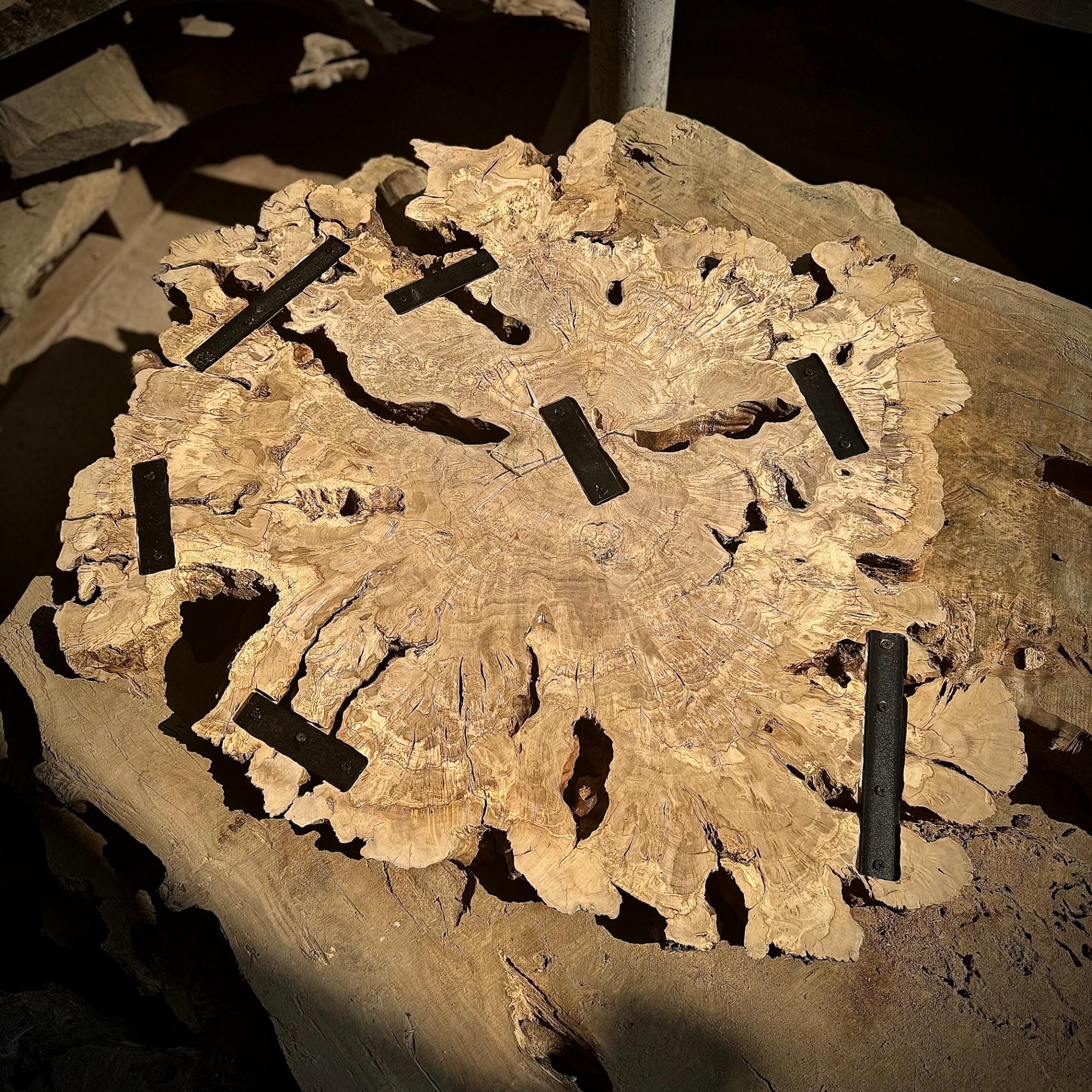
Choose an olive wood coffee-table outline by testing it in the room before buying the wood. A full-size floor template helps you compare the natural shape with your seating, walking routes and everyday use. For an irregular root slice, both the widest projection and the narrower usable areas matter. The photograph shows the underside of an irregular olive root slice with dark metal bars. Its outline is useful for thinking about shape, but the photo does not show a completed coffee table or establish which base would suit it.
How do you test the shape beside your sofa?
Draw the proposed outline on paper or cardboard using confirmed dimensions. Place it on the floor where the table will stand. Include distinctive projections rather than simplifying an irregular slice into a circle or rectangle; those projections may be the parts nearest a walking route. Sit in the seats you normally use, then walk around the template. Check access to adjacent chairs, drawers, storage and doors. Move the template until the arrangement works for your room. Choose the final dimensions from this trial instead of treating an attractive product photograph as a scale drawing.
Which parts of the surface will you actually use?
Mark a place for a tray, book or other item you regularly set down. Distinguish the outer outline from a continuous usable surface: a deep recess or opening may sit inside the overall footprint. Decide which openings you want retained and which would be addressed in the finished design. For a hypothetical example, two root slices could fit inside the same measured rectangle while offering very different spaces for a rectangular serving tray. Overlay the tray footprint on each outline. That simple comparison is more useful than choosing from maximum width alone.
Should you choose a root slice or a river-table layout?
A root slice lets an existing irregular outline lead the composition. A two-piece river layout gives you a separate decision about the position and width of the centre channel. Compare the shapes against the same room template so that the design choice remains connected to how you will use the table. Our guides to choosing an olive root outline and selecting wood for an epoxy river table cover these two starting points in more detail.
When should you choose the base?
Choose the base alongside the top. Ask your maker to assess support, attachment positions, finished height and stability for the specific design. Include an underside photograph in that discussion, particularly when a slice already has bars or other visible preparation. Check the base's footprint against the floor template as well as the top. Its position affects the appearance from a seated viewpoint and the space available around nearby feet. A photograph of reinforcement does not by itself confirm compatibility with a proposed base.
What makes a useful coffee-table brief?
- A room photograph and the tested tabletop outline.
- Target finished dimensions and height, with units.
- Preferred treatment of openings and natural edges.
- The intended base and any underside requirements.
- The selected listing and the preparation to be quoted.
Explore olive wood slices and slabs, then send the listing with your room-layout notes. Confirm what the listing includes before comparing the total project with a finished furniture purchase.