
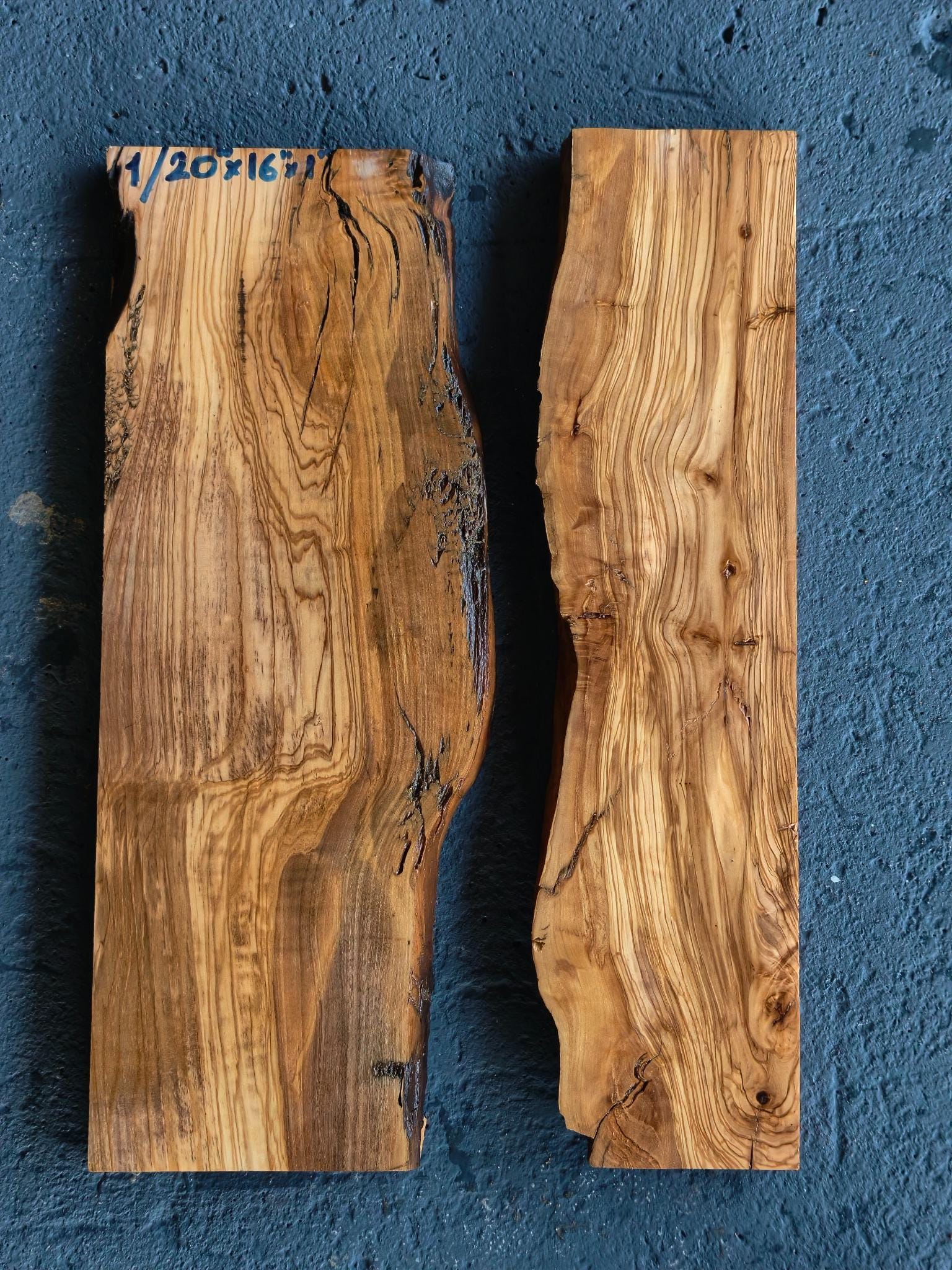
An olive wood desk top should fit the way you work as well as the room. Before choosing a slab, map the space for your keyboard, screen, mouse and chair. Then compare that working area with the usable outline of the wood, including any narrow sections along its natural edge. The photograph shows two separate olive wood pieces with long grain lines and different edge profiles. They illustrate material selection; a desktop, base and completed finish are not shown.
How much working space will your desk need?
Arrange your actual equipment on a table, or draw its footprint on paper. Include the objects that stay on the desk while you work: a notebook, speakers, lamp or second screen can change the layout considerably. Try the arrangement with your chair in place before deciding on the finished dimensions. Measure depth at the keyboard position and behind the screen, rather than relying only on the slab's widest point. A generous curve at one end cannot compensate for a narrow area where the mouse must sit. Our guide to usable width and overall slab size explains how to separate these measurements.
Where should the live edge face?
A natural front edge makes the outline part of your everyday workspace. Trace that edge onto a full-size paper template and try your usual seated position. Mark where your forearms, keyboard and mouse will be. Discuss any projections or recesses in that area with your maker before committing to the final shape. A straight working edge with a natural edge at the rear is another design option. For a wall-facing desk, include the required space behind the screen, the route of power leads and any gap between the wood and the wall. These choices should be settled before the slab is trimmed.
Will a monitor arm or cable opening change the plan?
Yes. A clamp-mounted monitor arm needs an accessible fixing area that meets its manufacturer's requirements. Ask your maker to check the proposed location against the actual thickness, underside shape and nearby openings. The overall dimensions in a listing do not establish hardware compatibility. Mark cable holes, trays and the base on the same drawing. A cable opening that looks convenient from above may conflict with a frame below. Keep drilling locations provisional until the complete desk layout has been reviewed.
What should you send with a desk-top enquiry?
- Your intended finished length, usable depth and thickness, with units.
- A simple drawing showing equipment and the seated working position.
- The preferred front edge and the edge facing the wall.
- Details of the proposed base, monitor arm and cable management.
- The selected listing and the preparation you want included.
For example, a laptop-only writing desk and a two-screen workstation may need very different outlines even in the same room. Describe the actual use instead of asking for a standard desk slab.
How do you choose the next step?
Browse olive wood slabs for your desktop project, check the quantity and preparation stated in the individual listing, then compare your template with the supplied dimensions. Read raw, prepared and finished olive wood before ordering, or send us your listing choice and workspace plan for a focused enquiry.