
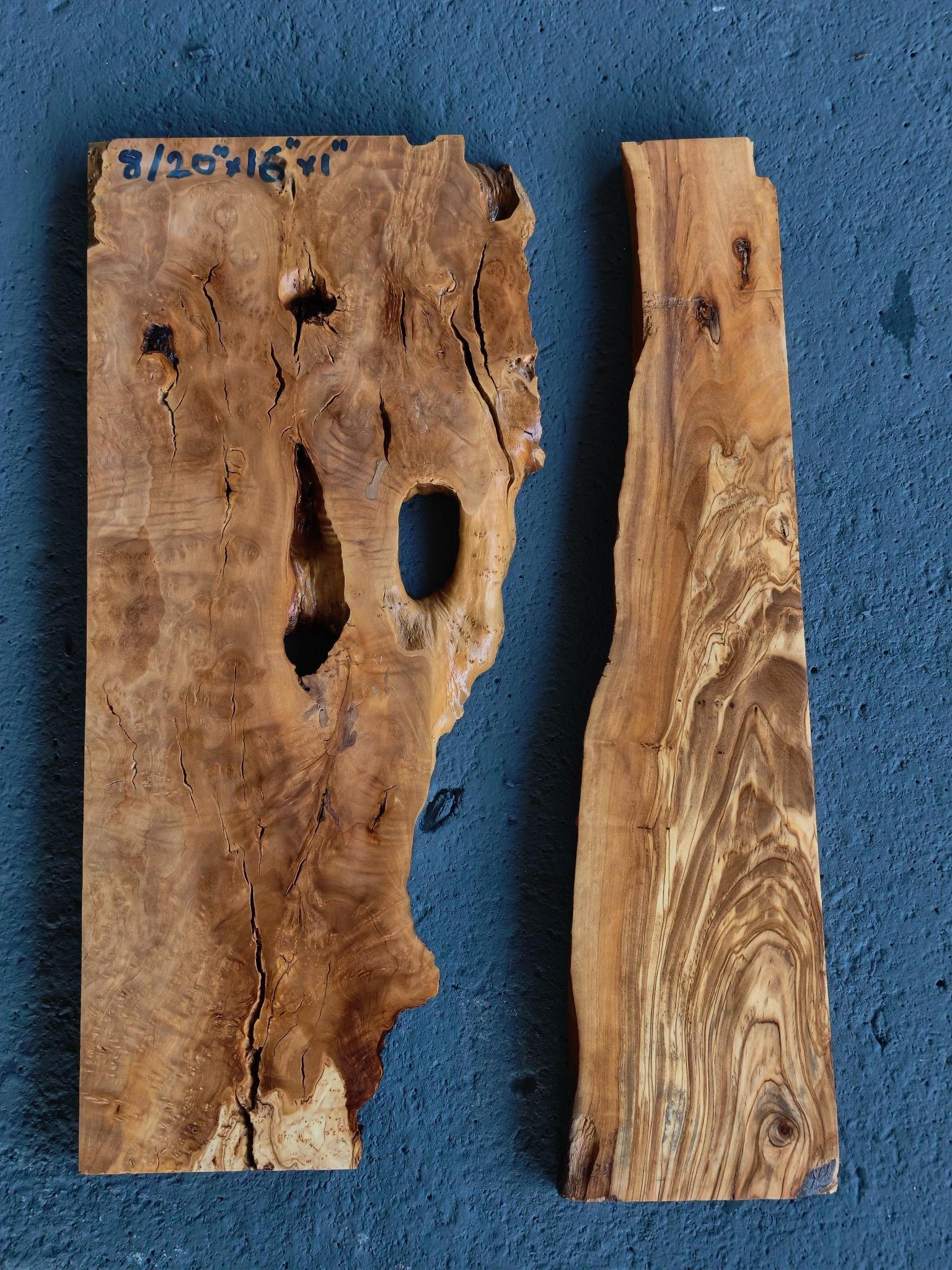
Compare olive wood slab prices by matching what each offer includes: quantity, dimensions, preparation and the type of piece selection. Calculate the cost for the material your project can actually use, then add the remaining work and delivery costs shown for your order. This produces a more useful comparison than price per listing alone. The photograph shows a broad piece with openings beside a narrower piece. A two-piece count tells you quantity; the shapes and usable areas still matter when you plan the finished project.
Are you comparing one piece or a defined set?
Record the quantity basis before comparing prices. One listing may offer an individual slab; another may offer a set with a stated number of pieces. Use the listing's definition rather than assuming every product called a set contains the same quantity. Counting example: if a listing explicitly defines one set as two pieces, four sets contain eight pieces. Price per piece is the total price for those four sets divided by eight. Price per set is that same total divided by four. Neither calculation changes what is included; it simply gives you consistent units for comparison.
Which dimensions matter to the project?
Write down length, width and thickness with units for each offer. For an irregular shape, ask how width is measured and whether the stated dimensions describe an individual piece or a combined arrangement. A river set's overall layout may include the open channel between its pieces. For a rectangular finished part, check whether your cut outline fits the useful area. For a project that keeps a natural outline, focus on the shape you will retain. A price-per-area calculation based on the widest outside rectangle can be a rough comparison, but it does not measure the usable wood around openings and changing edges.
What preparation is included in the price?
List the actual supplied condition alongside each offer. Then ask your maker which steps remain for the intended project. Keep wood preparation, resin work, finishing and fittings as separate lines. A completed furniture price and a wood-component price describe different scopes of supply. Check the photographs and description together. Identify whether you are choosing the photographed pieces or ordering from a selection illustrated by example images. That distinction helps you decide how specific your planned cut outline can be at the ordering stage.
Build a project total you can compare
- Wood or defined set price for the quantity required.
- Quoted preparation still needed for your design.
- Resin, finish, base or fittings required by the project.
- Delivery and other applicable charges confirmed for your order.
Use current listing, checkout and quotation figures. Keep an unknown charge marked “to be confirmed” until you receive the relevant amount. This guide gives a comparison method rather than a current price list.
A useful side-by-side comparison
Put two offers on a sheet of paper. Under each, write the included quantity, usable dimensions, supplied condition and remaining work. The stronger fit is the offer that satisfies your project requirements with a clear total scope and cost. Compare current OliveWoodSlab listings, then read how product photographs define the selection and how dimensions relate to usable wood. For an item-specific question, send both listing links and your finished project dimensions.