
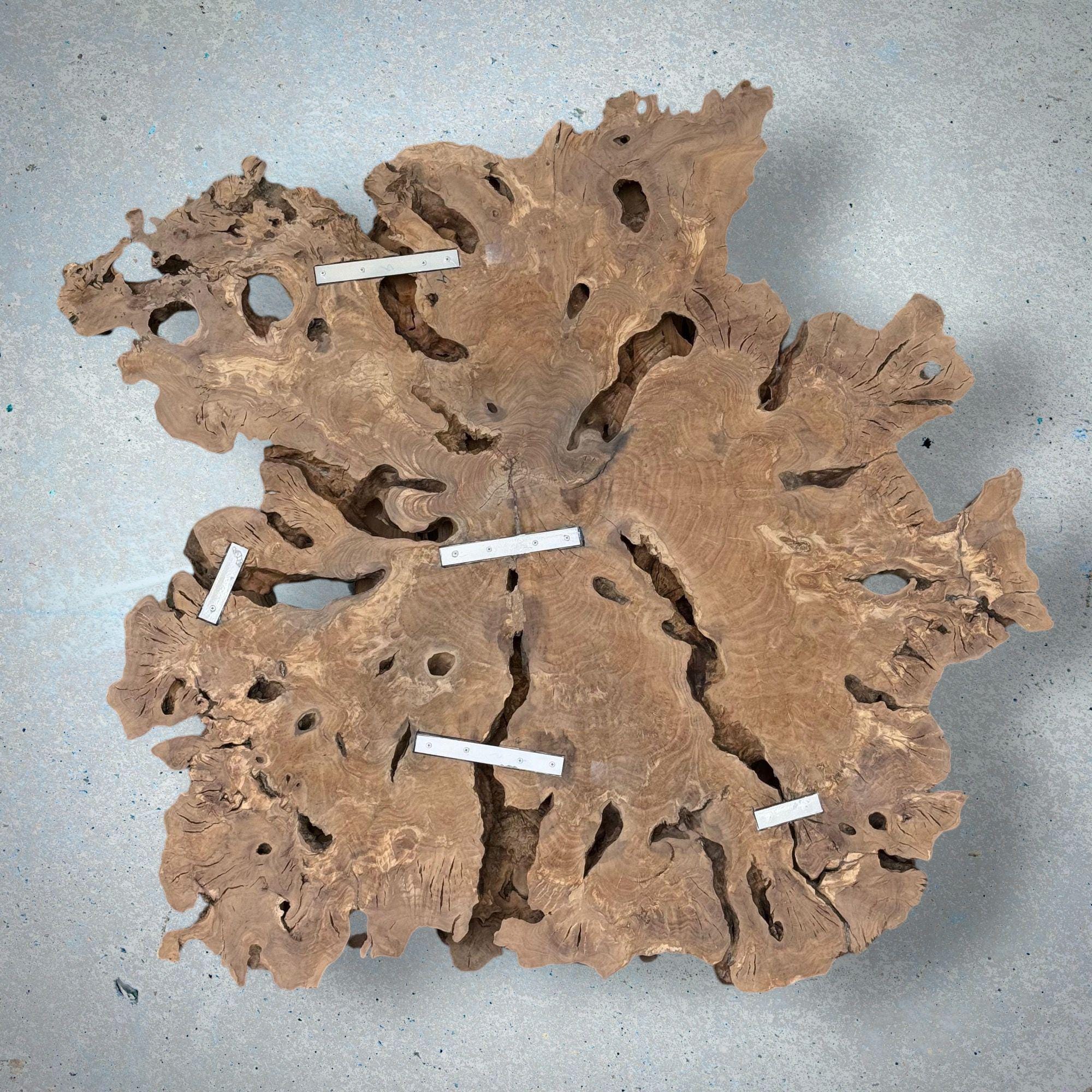
Olive root slices invite you to start with the wood's own shape. An opening, a branching edge or a broad area of grain can become the main feature of a design. The most useful comparison goes beyond choosing an attractive photograph: consider how each feature will work within the project you have in mind.
Begin with the outer silhouette
Look at the entire outline before concentrating on the grain. Some slices appear broad and compact, while others have more pronounced branches, curves or inward edges. Those differences affect how the piece sits within a round, rectangular or free-form visual composition. Sketch the approximate outline on paper and try several orientations. Rotating the drawing can reveal a different focal point without changing the material. If your project has a fixed outer boundary, place that boundary around the sketch to see how the shapes relate.
Give natural openings a clear role
An opening can act as the visual centre of a slice or as a smaller detail within the grain. Study its position, shape and relationship to the outer edge. An opening near the centre creates a different composition from one that reaches into the perimeter. Choose a slice whose existing features support your design direction. Product photographs help you identify those features, while any questions about suitability for a particular construction belong with the person designing and making that project.
Compare grain at the scale of the whole piece
Close-up photographs reveal local detail. Wider photographs show how those details connect across the slice. Use both views when available: a small area of swirling grain may look quite different when seen within the complete outline. Notice where the eye travels between lighter wood, darker grain lines and openings. You may prefer a broad uninterrupted area of grain or a more open, branching composition. Make that preference part of the comparison instead of treating every root slice as interchangeable.
Check dimensions and preparation separately
A root slice's stated width or size category should be read alongside its irregular outline. Review the actual dimensions and thickness provided for the selected product. A broad outside measurement does not necessarily describe an equally broad uninterrupted area of wood. OliveWoodSlab supplies kiln-dried olive wood from Türkiye. Cleaning, sanding and finishing details remain specific to each listing and selected option. Read them before planning the next stage of your project, especially when photographs show an application example as well as the material offered.
Follow the listing's photo-selection terms
Some listings identify the photographed piece; others explain how a piece is selected from the available product type. Use the terms on the individual page to understand what you are choosing. A distinctive root photograph alone does not establish that the pictured slice is the one supplied. Keep the piece reference with your notes when one is provided. It makes it easier to connect your preferred outline with the correct listing details.
Use a short selection checklist
- Does the outer silhouette suit the intended composition?
- Where will the main opening or grain feature sit?
- Do the stated dimensions and thickness fit the project?
- What preparation is included in the selected option?
- What do the photographs and selection terms say you will receive?
Explore olive root slices and compare their individual outlines. For a different starting shape, browse the complete OliveWoodSlab collection.