
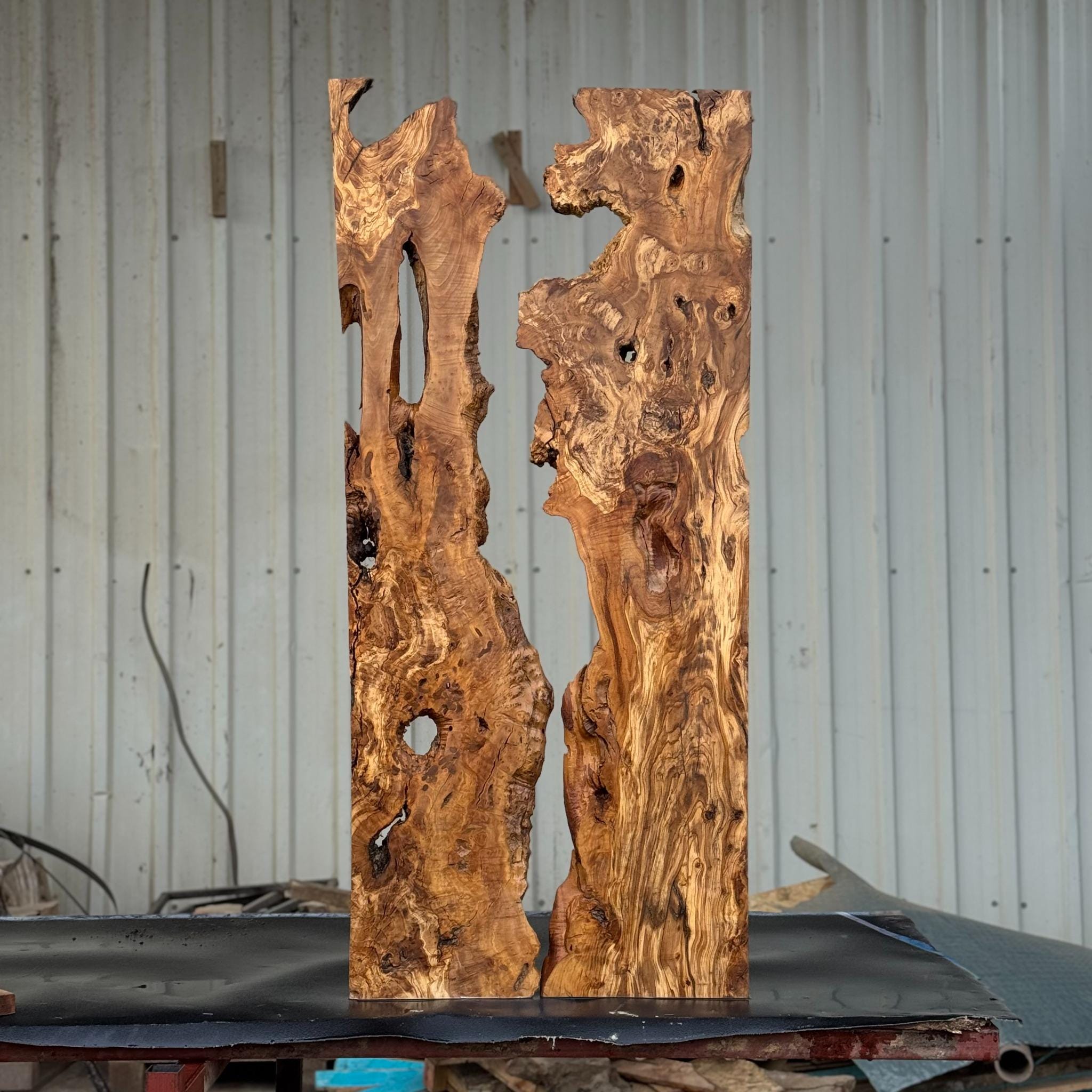
Bookmatched olive wood gives a design a relationship between two adjoining faces. That relationship can become the focal point of a tabletop or another wood project, especially when you give the pair a deliberate orientation. Start with the listed pieces, then plan the space between them and the outline around them.
Understand what bookmatched means
Bookmatching arranges related faces from adjacent cuts so the grain reads across the pair like the pages of an open book. The appeal lies in that relationship. Natural features and the finished layout can still create differences between the two sides. A listing should identify a pair as bookmatched before you rely on that feature. A two-piece olive wood river set can make an appealing composition without being a bookmatched pair. Compare the actual description and photographs rather than treating the terms as interchangeable.
Study the grain relationship before the gap
Look for the way major grain lines correspond across the two pieces. Then consider the direction in which you want that relationship to run through your project. It may suggest a clear centre line or a more flowing composition. Keep the relationship between the pieces visible while planning. Moving or rotating just one piece can alter the effect that first attracted you to the pair. Use a simple sketch to compare arrangements and keep the product reference attached to the version you prefer.
Give the centre gap a purpose
The centre gap is a design choice within the limits of your planned project. Its visual width affects how closely the two sides read together and how much attention the space between them receives. The natural edges may make that gap vary along the length. Consider both ends and the middle of the arrangement. A layout that feels balanced at one point may look quite different farther along the pair. Study the complete outline instead of judging the design from a single width measurement.
Separate pair dimensions from layout dimensions
Check whether the listed measurements describe each piece, the combined wood or the photographed arrangement. Overall layout width can include the centre gap, so it should not be confused with the amount of wood supplied. Record the stated length and thickness as well. Where widths are supplied at different positions, keep those readings separate. Our larger olive wood pieces provide another comparison when you are deciding between a paired composition and an individual slab.
Read preparation and selection details
Use the individual listing to confirm the supplied quantity, surface preparation and finish options. A photograph of a completed application can help you picture a design, but the product description establishes what is included in the purchase. Check the photo-selection terms too. If the listing identifies the exact pair, keep its reference with your plan. If it describes another selection process, follow that process when choosing the wood.
Compare the pair as a complete design
- Is the product explicitly described as bookmatched?
- Does the grain relationship suit your intended orientation?
- How do the natural edges shape the centre gap?
- Which measurements describe the wood and which describe the layout?
- What preparation and photo-selection terms apply?
Browse OliveWoodSlab's current collection for listed bookmatched pairs, or explore river sets to compare a wider range of two-piece layouts.