
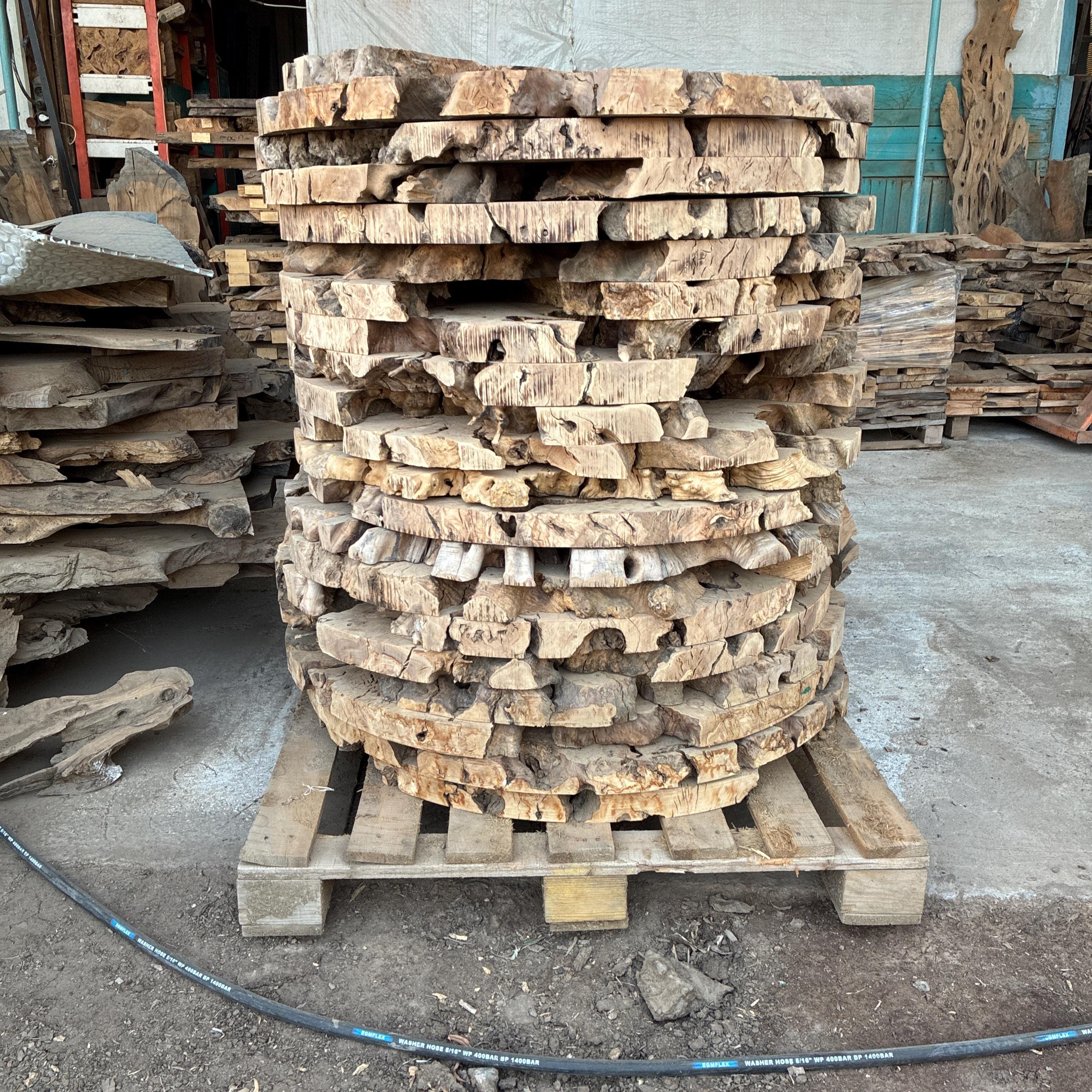
A useful wholesale olive root slice order is organised around the work each slice will become. Separate pieces for smaller resin art, furniture components and larger statement projects, then define the usable area each group needs. Maximum outside dimensions are only one part of choosing an assortment. OliveWoodSlab supplies olive root slices alongside other olive wood formats. Explore the olive wood and root-slice catalogue to identify the types you want, then send a grouped enquiry for the quantities, preparation and destination you have in mind.
Why is maximum diameter not enough?
An irregular root slice may be broad across one direction and much narrower across another. A deep recess can also sit inside the outer footprint. For a project needing a continuous working surface, record that useful area separately from the longest outside measurement. Describe how you want the supplier to measure each size group. For example, ask for two perpendicular overall dimensions and identify any minimum continuous area that matters to your design. Agree the measurement basis rather than assuming every slice described as round forms a complete circle.
How do you build an assortment around projects?
Give each group a purpose. A compact outline for a decorative panel, a broad slice for a side-table project and a sculptural piece with open spaces have different selection priorities. Use drawings or paper templates to show the useful areas you need. As an illustrative order plan, a workshop could request ten slices for a small format, six for a medium format and four for individually planned furniture pieces. Those 20 slices should appear as three specification lines, with dimensions and preparation against each line. Ask which parts of the proposed mix can be supplied before fixing the order.
How should natural openings be described?
State whether openings are welcome within the design, acceptable outside the working area, or something you need reviewed individually. A broad statement such as “interesting grain” does not tell the supplier whether a large central cavity would suit your product. The photograph accompanying this guide shows an underside with openings and metal bars. It illustrates details worth checking for a selected piece. If your project uses a base, concealed mounting or further machining, include the underside in the discussion and confirm any preparation that is part of the quoted item.
Do all pieces need the same visual character?
Choose how much variation your collection can accommodate. You may want a family of similar outlines for a display, or a broader selection in which every piece becomes a different project. Keep appearance preferences separate from essential usable dimensions so both are understood. Where individual selection is offered, connect the chosen photographs to a reference in your order. For an agreed assortment, describe the selection criteria in writing. Our guide to exact pieces and example photos explains the difference between these buying methods.
What should be recorded when the order arrives?
- A stock reference and photograph for each slice.
- The overall dimensions and the intended useful area.
- The project group assigned to the piece.
- Visible preparation and any work still planned.
- Features your maker needs to review before fabrication.
This creates a practical connection between the assortment you bought and the jobs your workshop can schedule. It also gives you specific feedback to use in the next enquiry.
How do you request the right wholesale assortment?
Use our root-slice outline guide to prepare your project groups, then request a wholesale olive root slice quotation. Include quantities, dimensions, preparation and destination. If you are combining slices with river sets or slabs, follow the shared wholesale order format so each group remains clear.